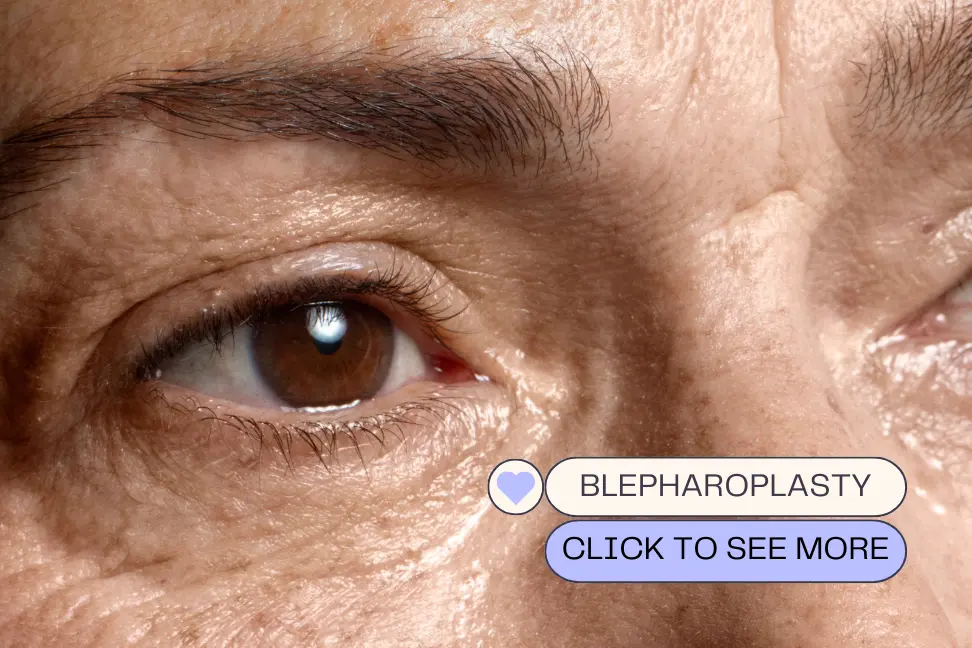
The eyes are often regarded as windows to the soul, but ageing can distort these windows, creating a reflection that doesn't quite match the spirit within. Forehead wrinkles, tension, and occasional headaches often accompany the eye opening process and unfortunately, with time, their impact becomes more pronounced. Drooping eyelids or under-eye bags are common issues for both men and women. It's not uncommon for relatively young individuals to seek consultation as well due to the annoyance caused by these concerns. If you're willing to tolerate temporary bruising around the eyes for a week or two, the results of treatment can provide years of satisfaction.
What is eyelid surgery?
Eyelid surgery, also referred to as blepharoplasty or an eye lift, is a cosmetic procedure that helps rejuvenate tired-looking or droopy eyes. The skin's elasticity is negatively affected by ageing. Therefore, the delicate skin beneath the eyes is pulled down by gravity, which causes bags under the eyes or drooping eyelids to develop. With age, the muscles that surround the eyes also weaken, giving the skin a wrinkled, bulging appearance.
It is possible to remove extra skin and/or fat from the lower and upper eyelids. The majority of upper eyelid surgeries are done as outpatient procedures, which means that patients are released from the hospital the same day as their operation. Anaesthesia, either local or general, is used during upper eyelid surgery. Surgery on the lower eyelids is only done under general anaesthesia. In most cases, particularly when performing upper eyelid surgery, a surgeon will inject numbing drugs under your eyes and give you sedatives via an intravenous catheter. Typically, incisions are made inside the pink part of the lid (transconjunctival technique) or above the lash line.
Upper eyelid surgery for medical reasons
In addition to making one appear significantly older, severely hooded eyelids can cause vision problems that can make it difficult to do everyday tasks like driving. Eye lift surgery is medically necessary when droopy eyes cause peripheral vision loss, especially in the top and side portions of the visual field. Patients who have blepharoplasty recover their normal eyesight, become more attentive, and are able to drive safely.
In addition, eyelid surgery could be necessary to treat inherited conditions such as ptosis. If left untreated, it may worsen eyesight further and result in additional disorders, including astigmatism or amblyopia.
Different types of lower eyelid surgery
Wrinkles appear as the skin under the eyes ages and becomes looser. Bags under the eyes might occasionally form from fat that moved from its original location around the eyes. A few distinct surgical procedures are available for use when a patient chooses to get lower eyelid surgery.
- Transconjunctival incision
Initially, a cut can be created inside the eyelid's pink portion. This procedure, known as a transconjunctival incision, enables excess fat to be extracted directly. This kind of incision heals quickly and without scarring.
- Subciliary incision
An alternative method is referred to as a subciliary incision. This time, the incision is made only two millimetres below the lash line. This kind of incision is made by surgeons when a significant amount of extra skin needs to be removed. Additionally, a smoother eyelid can be achieved by tightening the muscles. When it's necessary to soften the tear troughs or fill in the hollows surrounding the eyes, fat transfer or repositioning might be performed.
Can other surgeries be combined with eyelid surgery?
Drooping eyelids and bags under the eyes can be corrected with eyelid surgery to restore a more natural-looking eye contour. Blepharoplasty, however, can not be used to treat wrinkles that form around the eyes (such as crow's feet), remove wrinkles on the forehead, or realign the eyebrows. Therefore, blepharoplasty alone might not be sufficient in many circumstances to meet one's aesthetic goals.
Thankfully, facelifts and forehead lifts are two rejuvenation techniques that can be combined with eyelid surgery. In order to achieve maximum results, completing several procedures at once can reduce costs and time associated with travel and recovery time.
- Combination with forehead lift
For instance, blepharoplasty and forehead lift operations will lift the eyebrows, treat drooping forehead skin, and adjust upper eyelids. The eyes will look significantly more youthful as a result of the brows being positioned in proportion to the rest of the face.
- Combination with facelift
Combining a facelift with eyelid surgery might result in a dramatic makeover. For patients who want to reduce the wrinkles around the face and neck and rejuvenate their eyes, this kind of combination can be ideal.
Who is a suitable candidate for eyelid surgery?
- Individuals with good general health make the best candidates.
- The goal of ideal candidates should be to eliminate bags beneath the eyes and hooded eyelids.
- The majority of patients are over 35, but some may choose to have it done sooner if they feel concerned about drooping eyelids.
- It's also crucial to set reasonable expectations. Keep in mind that eyelid surgery can not stop the effects of ageing or alter your fundamental appearance.
- Individuals with long-term medical conditions like diabetes, heart problems, and blood clotting issues are also eligible for the treatment. It is essential to let the surgeon know about any current medical conditions so that the team can plan ahead and avoid any potential complications.
Recovery
- You are going to wake up from anaesthesia in a recovery room shortly after the procedure. You will be released from the hospital to recover at home if all goes according to plan.
- In the beginning, you may be experiencing double or blurred vision, watery eyes, numb eyelids, light sensitivity, swelling, and bruises that resemble black eye. Any specific painkillers you are required to take will be disclosed to you by your doctor. You may minimise bruising and swelling by sleeping with your head slightly elevated. It might be necessary to carefully clean eyes using prescribed ointments. It will be required to use eye drops to keep the eyes from drying out.
- Most patients are well enough to go on brief trips after about a week. The bruises should go away in ten to fourteen days. You should feel comfortable enough to step out into public again by then. After an eyelid lift, patients usually return to work in 10 to 14 days. To avoid straining your eyes, try to gradually increase your workload if your job involves spending a lot of time staring at a computer screen.
- Until your surgeon provides permission to resume driving, you should not drive.
- Above all, refrain from intense physical activity, swimming, and heavy lifting for four weeks. For at least two weeks, avoid wearing contact lenses. You should always wear sunglasses when you're outside in the sun to shield your skin and eyes from the light.
What are possible risks?
Given that eyelid surgery affects one of the body's most delicate areas, it is understandable that many potential patients are concerned about their vision following the procedure. Contrary to popular belief, blepharoplasty significantly improves vision. Patients' eyesight improves when excess skin and fat around the eyes are removed.
Complications are more likely to occur in patients with high blood pressure, on blood thinners, or on aspirin. Vision loss following eyelid surgery occurs in an extremely rare - 1 in 30.000 surgical cases. Thankfully, it happens so rarely that most surgeons have never seen this happen in their professional lives.